How Festival Keepsakes Carry a Gathering’s Story
Festival keepsakes can be tickets, notes or bought souvenirs. Learn how to tell their roles apart and choose the detail that brings a gathering back.
A folded programme can recall a festival more sharply than a mug printed with its name. Festival keepsakes are not a single kind of object: the term describes what an item means to the person who keeps it, while “souvenir” usually describes something chosen or made to recall a place or occasion.
That difference is more useful than a simple story of keepsakes evolving from accidental tokens into merchandise. A ticket may begin as proof of entry and later become a personal reminder; a souvenir may be bought for its design and acquire a more particular meaning through use. The object’s role can change, even when the object itself does not.
A keepsake is defined by its role, not its material
A festival keepsake is something retained because it brings a particular gathering to mind. It might be a ticket, a ribbon, a handwritten programme or a leaf picked up along the route. What matters is the connection its owner can name: a person, place or moment.
A souvenir is commonly made, selected or sold as a reminder of an event or place. The terms overlap rather than divide objects into fixed classes. A purchased badge can become a keepsake, while a ticket kept after the event can serve as a visitor’s souvenir.
This distinction avoids a false choice between personal and commercial objects. One describes an object’s origin or intended use; the other describes the meaning it has for its owner. A single object can do both jobs.
Look at the object’s purpose before telling its history
Without a named event, date or reliable source, it is better not to claim that one type of festival token came before another. A personal account can tell us what one visitor kept, but it cannot establish a general history of festival customs. Claims about a specific tradition need evidence tied to that place and period.
For a particular festival, useful clues include dated programmes, printed tickets, organisers’ records, photographs and local newspaper notices. These can help establish when an item was used and whether it was intended for entry, publicity, sale or exchange. An object alone may not answer all those questions.
Say a visitor finds a dated programme and ticket in a family album, alongside a note naming a friend who attended. The items support a limited account: the programme and ticket are associated with that gathering, and the note records a personal connection. Without further documentation, they do not establish when the festival began selling souvenirs or what other visitors did.
Separate personal mementos from event merchandise
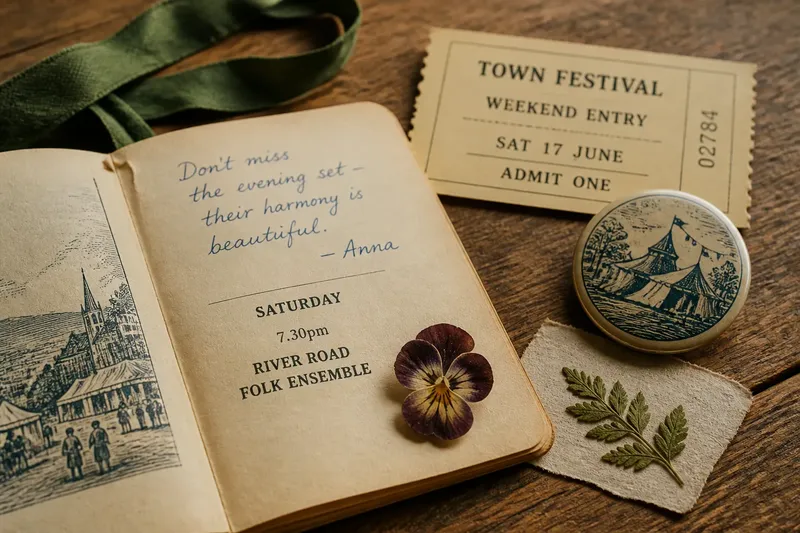
Personal mementos often carry details that mean little to anyone outside the owner’s circle. A note in the margin, a borrowed ribbon or a pressed flower may prompt a vivid recollection without identifying the festival to a stranger.
Event merchandise is usually designed or offered for visitors to recognise the gathering. A printed emblem, date or place name can make that connection legible. But a design does not determine how deeply its owner will value the item; a bought postcard may become personal through the memory attached to it.
When describing an object, be precise about what is known. “A programme kept by a visitor” says something different from “an official festival souvenir”. The latter implies a connection to organisers or a planned sale, which should not be assumed from the object’s appearance alone.
Choose what to keep by the story it can carry
A modest object can preserve a useful detail if its owner adds context. Write a name, place or brief recollection on a programme, or store a ticket with a note about the performance it recalls. The note supplies what the object may not: a clue to why it mattered.
If you are sorting festival objects, use these observations to decide what stays and what might be recorded another way:
- If a ticket has a date or venue that you still recognise, keep it with a short note; if it has no identifiable connection, photograph it and consider letting the paper go.
- If a programme contains a performer’s name or a handwritten detail you want to recall, retain that page; if the information is available elsewhere and carries no personal memory, recycle the copy where local rules allow.
- If a ribbon or badge was given by someone you remember, keep it with that person’s name; if it is only one of several indistinguishable items, choose one representative piece or record the rest in a photograph.
- If an object’s material or condition makes it difficult to store safely, ask a conservator for advice when the item is valuable or fragile; otherwise, record its story and choose a more suitable way to preserve the memory.
- If a souvenir clearly names the festival and recalls a particular day, keep it as both merchandise and personal keepsake; if it has no meaning beyond its branding, decide whether a photograph is enough.
- If a scrap of paper has no visible date or name but you can still identify its moment, add that context before storing it; if you cannot identify it, keep it only if uncertainty itself matters to you.
Imagine you are sorting a programme, an entry ticket and a purchased badge from the same town festival. The programme has a friend’s handwritten recommendation, the ticket shows the event name, and the badge has no personal association. Write the friend’s name and the performance beside the programme, keep the ticket with it because it identifies the occasion, and photograph the badge before donating it. The resulting pair preserves both a personal detail and a trace of the event, while the image records the badge without requiring another object in storage.
How should you describe a festival keepsake?
Is a ticket stub a souvenir?
It can be, if someone keeps it as a reminder of attending. It starts as an entry document; its later role depends on the owner’s reason for retaining it.
Does official merchandise count as a keepsake?
It can, but official status and personal meaning are separate questions. A branded item may remain an ordinary purchase, or it may recall a particular person or moment.
What evidence supports a claim about a festival object?
A dated item, event records, photographs or contemporary notices can help establish context. For a specific historical claim, check what those sources actually show and avoid extending one object into a general account.
How can I keep a souvenir from becoming clutter?
Name the moment, person or place it recalls, then decide whether the object itself helps preserve that connection. If a note or photograph would serve just as well, you can keep the memory without keeping every item.
A festival keepsake needs only one clear connection
There is no need for a keepsake to represent an entire gathering. A ticket may recall the route home; a programme may preserve a friend’s handwriting. These are different kinds of evidence: one may identify the event, while the other holds a private association.
For festival keepsakes, a brief note is often the most useful addition. Record what the object cannot say for itself, and future readers—including you—can distinguish an event souvenir from the personal story that made it worth keeping.