Long Table or Small Stations: Two Ways to Share Festival Food
Compare a long table with small stations for festival food, and choose a layout that suits the menu, site and the way guests gather.
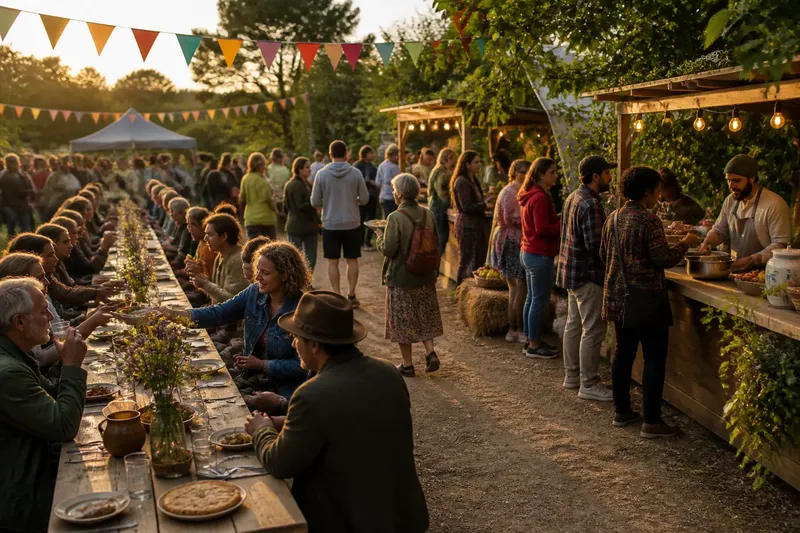
A long table or small stations can change how festival guests move, meet and eat before anyone takes a bite. A shared table gathers people around one visible centre; separate stations send them along several smaller routes. The choice affects who meets, where queues form and whether conversation happens while eating or while choosing.
Neither arrangement is automatically more communal. A table can leave guests stranded at opposite ends, while well-placed stations can prompt easy encounters. The useful question is not which layout looks more festive, but what pattern of movement the food and setting can support.
A long table makes the meal visible as one gathering
A continuous table gives the meal a clear centre. Guests can see where food is being passed, where seats are open and who is already settling in. That shared view suits menus meant to be eaten together, such as bread, salads, pies or platters that can travel along the table.
The arrangement also makes conversation relatively steady. Once seated, people can talk to those beside them and across the table, though a long surface may divide into smaller conversational pockets. A narrow table helps voices carry; a broad one can make the far side feel distant, especially outdoors where wind and crowd noise interfere.
Passing dishes creates a small rhythm of exchange. Someone asks for the bowl, another makes room, and a third points out what is inside. These gestures can include people who arrived together and give strangers a low-pressure way to interact. But they depend on food that is easy to pass and enough clear space for hands, plates and serving utensils.
Access matters as much as atmosphere. A long table needs a route to seats and a way for people to leave without asking everyone to stand. If benches are fixed, guests may have trouble reaching a seat in the middle or stepping away when they need to. Separate gaps between table sections, clear ends and a nearby space for mobility aids can make the shared arrangement more usable.
Small stations turn choosing food into a route
Stations distribute the meal across a site. One might offer bread and spreads, another a hot dish, and a third fruit or tea. Guests move between them, often in small groups, so the meal unfolds as a sequence rather than a single moment of sitting down.
This can spread activity across a busy area. Instead of one queue at a serving point, several shorter lines may form. It also gives people a reason to circulate and meet others away from their own group. The effect depends on where stations sit: if every guest must visit each one in the same order, separate counters can still create one long, slow procession.
Stations suit food that is best served separately or needs different handling. A hot pot may work well with its own attendant, while drinks can be placed away from the main food queue. Distinct signs, visible menus and serving tools at each point help guests understand what is available without having to ask repeatedly.
The trade-off is that conversation can become temporary. Guests talk while waiting, choosing or walking together, then split up to find seats. If seats are scattered or far from the food, people may carry plates across the site and lose the chance to eat with those they came with. A few shared benches or standing tables near, but not blocking, the stations can give the routes a place to pause.
Choose the layout by tracing what guests will carry
Start with the food rather than the furniture. Ask whether guests need a plate, a bowl, both hands, or help carrying a drink. A menu of handheld savouries and cups can move comfortably between stations. Food that needs a knife, a stable surface or several dishes is often easier to serve near seats.
Then trace the route from arrival to eating. Where does a guest first learn what is being served? Can they see the next point in the route? Is there a place to wait without blocking someone who is leaving? At a long table, trace the route from entry to an open seat and back out again. A simple sketch on paper can reveal crossings that are hard to notice while imagining the event.
Say a community festival has a narrow courtyard, a shared vegetable pie, bread and a jug of cordial. Imagine placing all the food on a long table against one wall. Guests could serve themselves and sit at nearby benches, but the serving queue might block the entrance. Moving the cordial to a small side station could free that route while keeping the pie and bread close to the shared seating. The expected observable result is a clearer entrance and less traffic passing through people who are eating.
For a larger open field, several stations may help guests approach from different directions. For a compact hall, one table may make the meal legible without sending people across the room. The site’s shape, surfaces and weather exposure matter: grass can be awkward for laden plates, while a paved area may make a station queue conspicuous if it cuts across the main path.
Keep queues and conversation from competing
How can a station queue avoid blocking the meal?
Place the line along an edge rather than across the route to seats, toilets or exits. If the queue reaches a path, move the station or redirect its approach; if it stays clear of those routes, keep the serving point there and mark the line’s direction plainly.
Does a long table work for guests who arrive at different times?
It can, if seats remain easy to identify and late arrivals can join without interrupting a settled group. If serving dishes narrow the only open seat’s access, move the dishes; if the seat remains reachable, keep the arrangement and leave it available.
How can stations support conversation?
Give guests a shared place to pause, such as a bench or standing table near the food but outside the queue. If people can reach it without crossing the line, retain that position; if it obstructs the queue or walking route, move it to a nearby clear area.
Which layout is easier for guests with different access needs?
Neither layout is inherently easier: the route, surface, queue and serving height all matter. If the site cannot provide a clear route or suitable seating at the chosen arrangement, adjust the layout with organisers and ask guests what access changes would help; if those features are in place, keep checking that they remain unobstructed.
Hybrid layouts can give the meal a centre and a route
A festival does not have to choose one arrangement for every dish. A central long table can hold shared breads and cold platters, while drinks or a specialist dish sit at a separate station. This preserves a place to gather without making every choice depend on one crowded surface.
Keep the distinction clear. If guests cannot tell which food is at the table and which is elsewhere, they may repeatedly cross the site or join the wrong queue. A small sign at the table can point towards the station, while a matching sign at the station can explain where to sit. Use plain wording and make dietary information easy to see.
Think about replenishment, too. A table works best when someone can reach serving dishes without squeezing between seated guests. A station needs room for the person serving to replenish food without standing in the queue. If food requires particular holding, serving or allergen information, follow the relevant label, organiser guidance and local requirements; consult a qualified food-safety professional where the event’s needs call for it.
What people remember may be less about the furniture than the ease of the meal. If they can see where to go, carry food comfortably and find a place to talk, the layout has done its work. For festival food planning, a long table is strongest when the meal itself invites passing and lingering; small stations work when movement is part of how guests encounter the menu. A hybrid can connect the two, so long as each route remains clear.